The missing part is continuity
Many AI image tools are organized around a prompt box and a final result. That works for a demonstration, but product imagery is an iterative job. A seller begins with several real photos, tries different compositions, compares model behavior, points out specific corrections and eventually hands the work to someone who may still need to edit text, layers or layout.
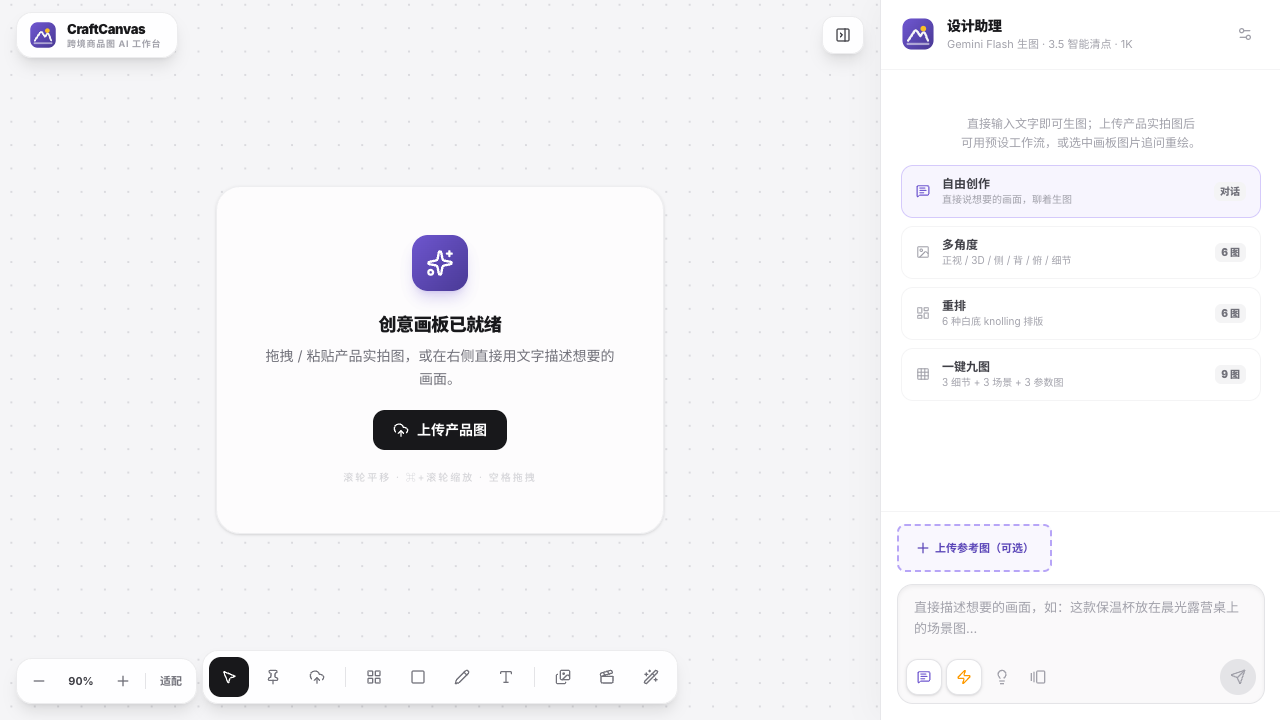
CraftCanvas started from that gap. Instead of treating each generation as an isolated request, it keeps the work on an infinite canvas where source images, generated variants and their relationships remain visible.
The canvas is product memory
A persistent canvas does more than provide extra space. It records how an output was derived. New images appear beside their source, collision detection prevents piles of overlapping nodes and connection lines preserve the relationship. A selected image or group can become the context for the next instruction without requiring the user to reconstruct the task.
Annotations follow the same principle. A pin, target point and leader line should make the requested change obvious at the place where it matters. Shapes, frames and local conversations let visual feedback stay attached to the work instead of disappearing into a long chat history.
Different jobs need different execution paths
CraftCanvas combines Gemini image generation, Gemini material analysis and OpenAI GPT Image behind one engine interface. Fast exploration, high-fidelity output, multi-reference editing and local image operations are not the same problem, so the product chooses the smallest capable path for each task.
The four preset workflows - free creation, six-angle product views, component rearrangement and a nine-image set - are starting points rather than locked templates. For parameter graphics, user-entered facts are injected directly and the prompt is instructed not to invent dimensions, power, certifications or other claims.
Delivery should remain editable
A flattened PNG is not always the end of the workflow. CraftCanvas can separate a result into background, product and text layers for PSD delivery, and it can trace suitable images into SVG. These exports are not perfect substitutes for a designer, but they move AI output closer to a file that can be inspected and continued.
What the project is teaching me
The difficult work is not adding another model button. It is managing context, cost, latency, failed requests, file sizes, batch progress and the difference between a plausible image and a trustworthy product claim. CraftCanvas is an ongoing attempt to make those constraints visible without making the workspace feel heavy.
Verified today, unfinished by design
The current production build succeeds and the live workspace can be used through the project link. The same check also exposes the next engineering priorities: the main JavaScript bundle is about 1 MB, several canvas components are too large, there is no automated test suite, and a public server-key OpenAI proxy would need authentication, quotas and rate limiting. A credible case study should show both the working product and the work still required to make it safer at scale.