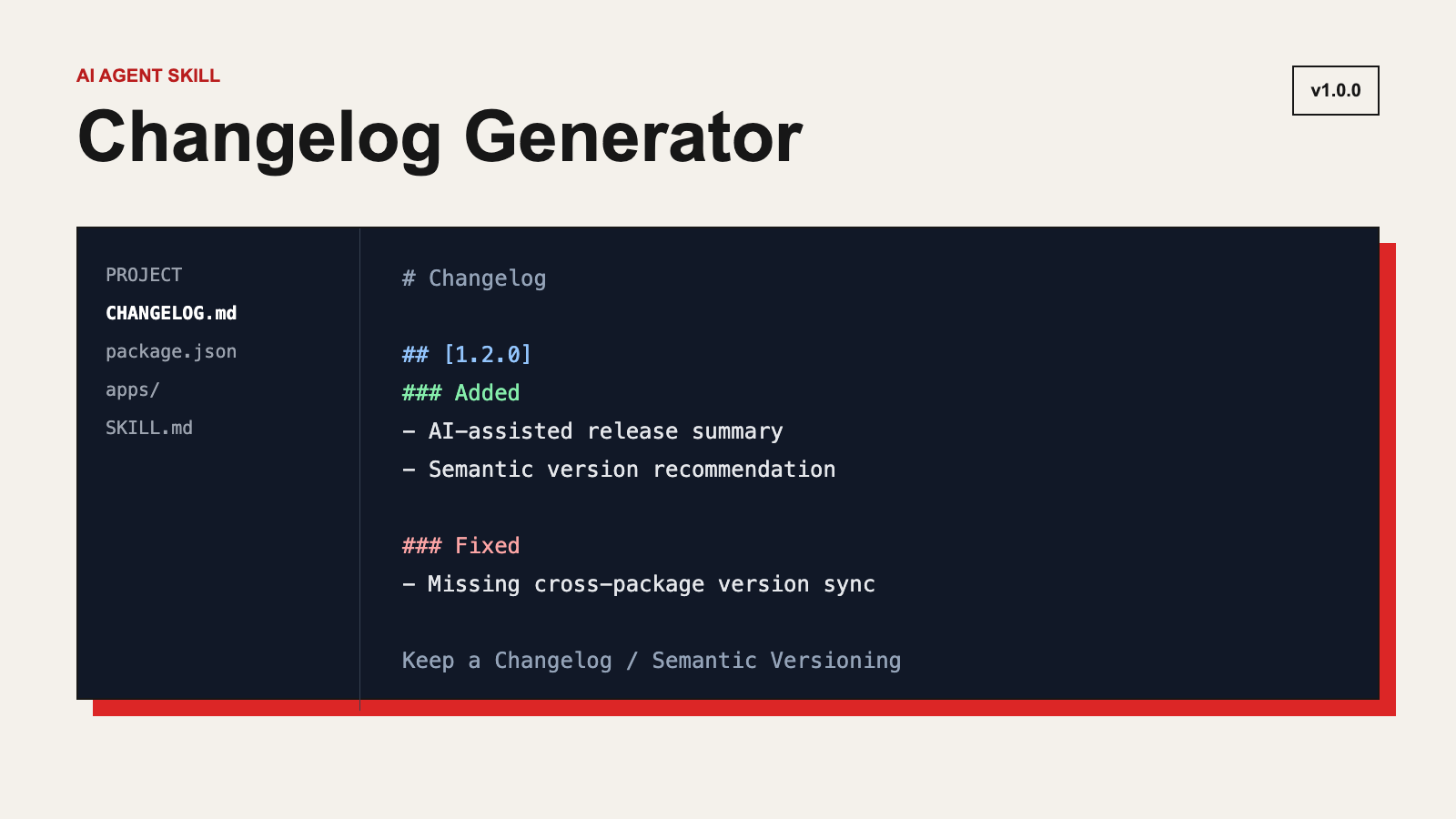
The useful idea is a shared release language
Agent-assisted implementation can move quickly, but a repository still needs a human-readable record of user-facing changes. Keep a Changelog and Semantic Versioning provide a useful shared language: separate additions, changes, removals, fixes and security work, then decide whether the release is major, minor or patch.
What version 1.0.0 actually contains
Changelog Generator packages that convention in a SKILL.md file. It instructs an agent to initialize a missing changelog, classify completed work, recommend a version and update package versions. The public repository contains that instruction file and a README. It has no executable script, parser, test fixture or output validator.
The gap between an instruction and a guarantee
The first version does not require a real Git diff, current tag comparison or dirty-worktree check before writing. It also assumes every package.json should receive the same version, which can be wrong for independently versioned monorepos. A fluent agent could therefore produce a plausible but inaccurate release record or modify unrelated packages.
A safer second version
- Inspect the working tree, staged diff, latest tag and existing changelog before drafting.
- Separate repository evidence from conversation context.
- Ask for explicit approval before changing versions.
- Support lockfiles, independent packages and non-Node manifests.
- Validate the generated sections and add repeatable fixtures.
Repository truth matters
The README currently says MIT, but the repository has no LICENSE file and GitHub does not identify a license. Until the legal file is added, I describe the source as public rather than open source. The value of this 1.0.0 release is a compact workflow convention; reliable automation is the next product milestone, not a capability I should claim retroactively.