Context switching is the hidden cost
Copying a file path, opening Terminal in a folder, renaming a group of files or converting images are all small tasks. The cost comes from leaving Finder, finding another tool, completing the action and returning to the original context. Super RClick treats that interruption as the product problem.
Start with deterministic tools
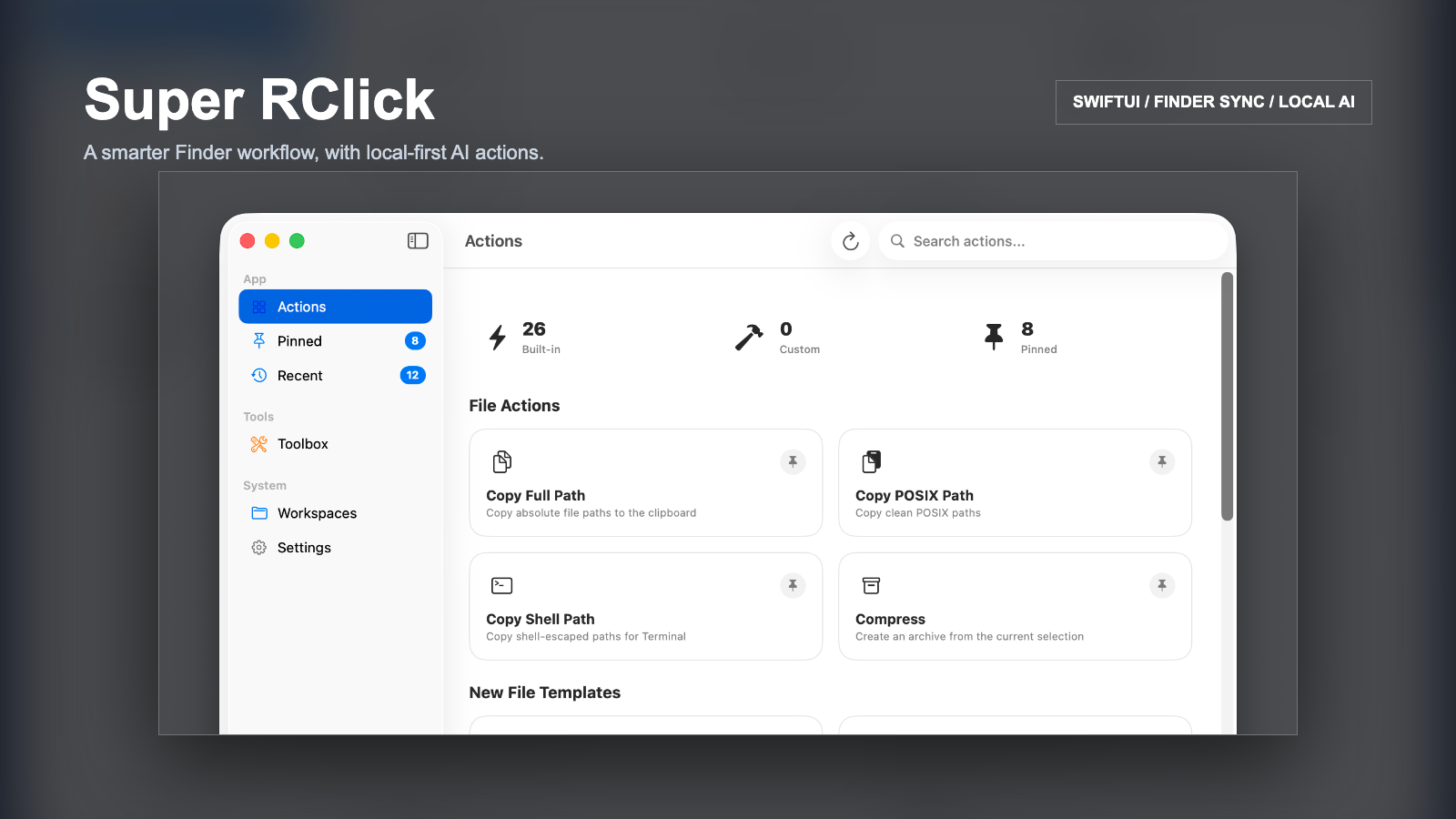
The foundation is a set of predictable actions: copy paths, compress selections, batch rename with a preview, convert image formats and create new files from templates. These tools do not need AI. They need clear options, conflict detection, progress feedback and a result that appears where the user expects it.
Add AI where the operating system already has useful capabilities
For image OCR and background removal, macOS already provides Vision and CoreML. Running these tasks locally protects privacy and removes network latency. Cloud models remain optional for actions that benefit from broader language understanding, with support for OpenAI-compatible providers and local Ollama endpoints.
This separation matters. “AI-powered” should not mean every file is uploaded by default. The product can choose the smallest capable execution path for each action.
Finder extensions require restraint
A context menu becomes worse when every possible action is always visible. Super RClick therefore includes visibility controls, pinned actions, recent actions and custom commands. The Finder Sync extension stays focused on selection context, while the main app and menu bar handle richer configuration.
The project reinforced a principle I also use in business software: put the action close to the decision, but keep the interface quiet enough that the next step remains obvious.
A working build is not a complete quality signal
The latest unsigned build of the app and Finder extension succeeds. The same review found that the test target no longer compiles because one test calls a removed batch-rename method, while the app coordinator remains a very large integration point. There is also a documentation and legal mismatch: the README says MIT, but the repository has no LICENSE file. The source can be inspected and the app can be downloaded, but I will not call it MIT-licensed or open source until that file exists. Fixing the tests, splitting the coordinator and aligning the license are more valuable next steps than adding another context-menu action.