Why I built it
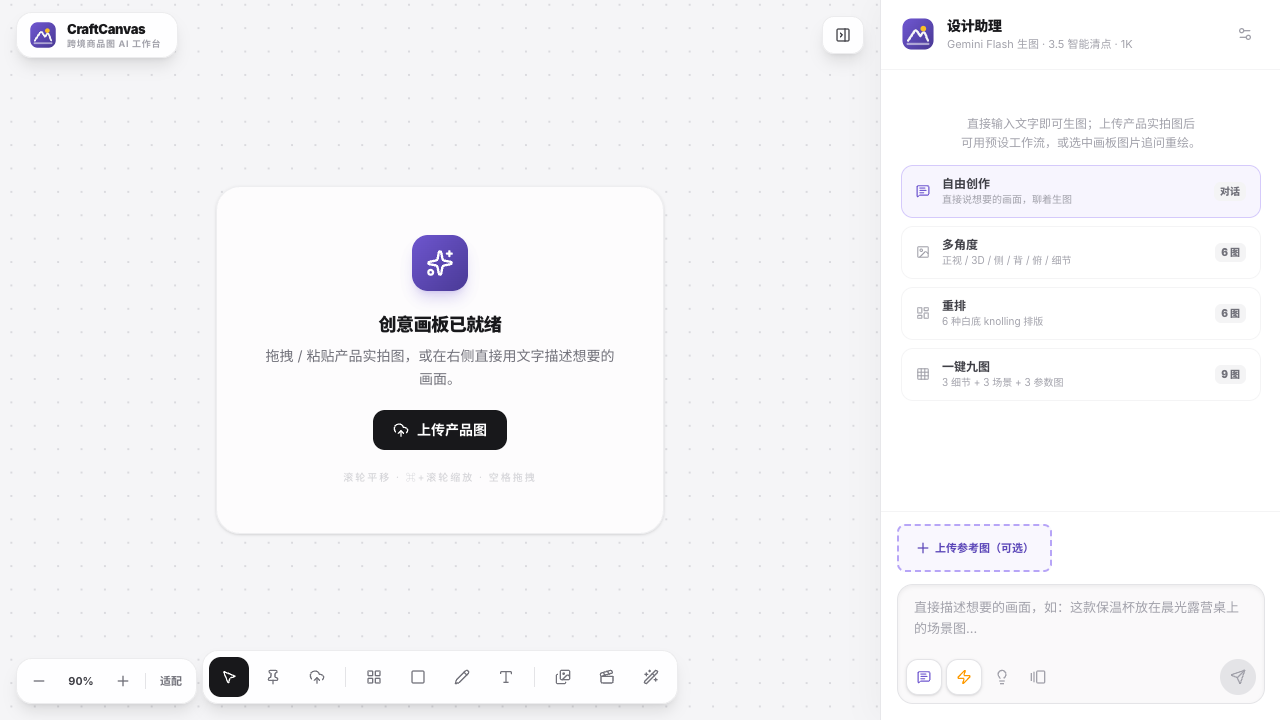
Product imagery is rarely finished after one prompt. A seller starts with real product photos, explores several directions, compares outputs, marks corrections and eventually needs files that can still be edited. CraftCanvas treats this as a continuous workspace instead of a single generation form.
The workspace model
- An infinite canvas keeps source images, generated variants and their relationships visible
- Conversational design lets a selected image or group become the context for the next instruction
- Derived images land beside their source with collision avoidance and connection lines
- Pins, leader-line annotations, shapes and frames keep visual feedback close to the target
- Batches can be located, reviewed and downloaded without losing the surrounding work
Four production workflows
CraftCanvas supports free creation, six-angle product views, multi-component rearrangement and a nine-image set containing details, real-use scenes and parameter graphics. User-provided parameters are injected into information graphics as facts; the workflow does not invent dimensions, power, certifications or other numeric claims.
AI and editable delivery
The product uses Gemini image models, Gemini-based material analysis and OpenAI GPT Image behind one engine interface. It also supports background removal, 4K upscaling, 16:9 outpainting, Touch Edit, batch editing, layered PSD export and SVG vector output.
The application is built with React, TypeScript, Vite and Tailwind CSS. Canvas state, generation batches, annotations and image relationships are maintained in the browser, while a Vercel Node function can proxy OpenAI Images for the deployed version. Gemini and local image operations use the smallest available execution path rather than forcing every task through one model.
Verified status and current limits
The current repository builds successfully and the live workspace is available through the project link. The repository remains private because it contains active deployment and product implementation details.
The product is already broad, but its engineering foundation still needs hardening: there is no automated test suite, several canvas components carry too many responsibilities, the production JavaScript bundle is about 1 MB, and a server-key OpenAI proxy needs authentication, quotas and rate limiting before it can be exposed beyond controlled use. These are the next reliability tasks, not hidden claims of completeness.